Tuesday, February 21, 2012

Inter AS---- Model B

In this case specific instances of VPRN is not required to be created on the ASBR

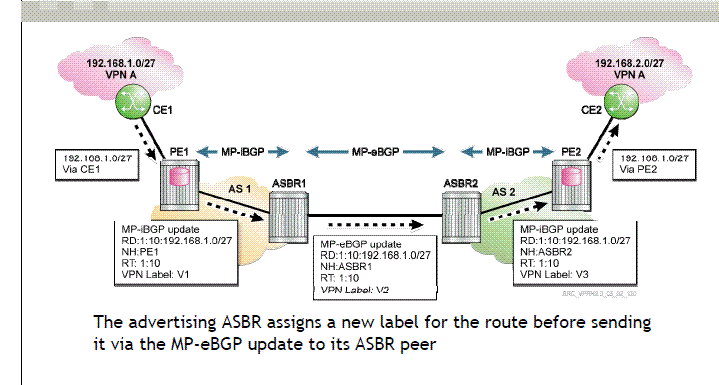
In this case mp-ebgp is used to transport vpn-ipv4 routes between the autonomous system

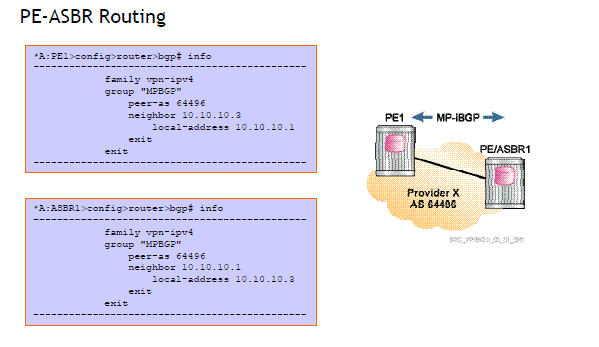
The PE and the ASBR are connected to each other using MP-IBGP the PE and the ASBR's are connected directly or are connected with the help if RR


The primary difference between MP-ibgp and mp-ebgp is the next hop attribute is changed when there is an ebgp session then when there is an mp-ibgp session

The LSP path terminates on the ASBR originating the update.

The ASBR has to assign a new label for the route before sending it via the mp-ebgp peer ie to its peer ASBR

See the figure for the detailed description of the routes being generated from one CE to another CE

Configuration for Model B:-

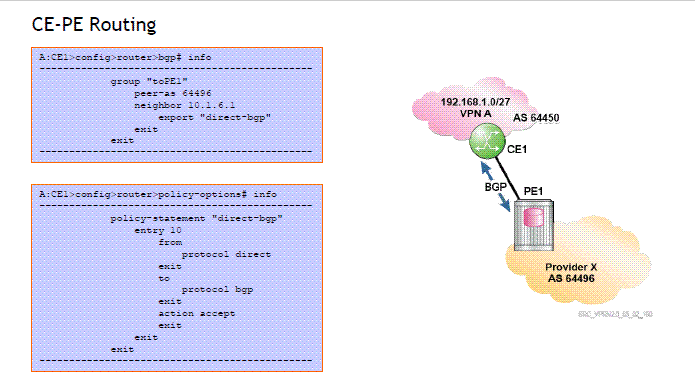
1> CE-PE routing:-


2> VPRN configuration on the PE:-


Configuration of MP-ibgp between the PE and the ASBR:-


For MP-EBGP between the two AS's use the command enable-inter-as-vpn


Verification:-

CE-PE routing verification:-

show router bgp summary

PE-ASBR routing verification

Show router bgp summary

ASBR-ASBR routing verification:-

show router bgp summary

CE routing table:-

show router route-table

PE route table verification:-

show router 10 route-table

As seen below when the route is advertised from ASBR2 to PE2 the next hop is modified as the next hop is modified the vpn label is modified as well. This is also true in the case when the labels are advertised between the ASBR's as well.


BGP inter AS label can be viewed by using the following command:-


Monday, February 20, 2012

Inter AS VPRN--Model A


This is used to interconnect vprn of customers connected to different service providers


There are 3 models the first model is known as VRF to VRF approach


Here the ASBR 's from two different AS's are connected directly


For each VPRN services there is a requirement of different logical or physical interfaces


ASBR of AS serves as a PE as well as a CE


EBGP is used to distribute routes to its peers


The above figure describes what happens in the control plane, 

1> CE1 advertises the routes 192.168.1.0/27 to PE1

2> PE1 adds a vpn label and transmits the route to PE/ASBR1

3> The vpn label is stripped of in ASBR1 and a ipv4 route update is sent to Pe2/asbr2

4> ASBR2 treats ASBR1 as a CE device and after it receives the update adds a vpn label v2 and sends the route to PE2

5> PE2 puts that under the appropriate service and transfers it to the CE


Configuration between PE and CE:-

1> Routing between CE and PE


2> VPRN configuration in PE:-


3> Verify that the BGP is in established state:-

show router bgp neighbor on the CE

4> Configure MPBGP between the PE1 and the ASBR


5> Show router bgp neighbor on PE will verify it is established with the CE router

6> Export policy mpbgp to bgp will redistribute the mpbgp routes to the bgp policy is given above.


7> show router 10 route table on the PE's shows us the route which have been distributed 


8> On CE devices use the command show router route table

9> 

EBGP is used to distribute the routes no requirement of MPLS between the two ASBR

Not Scalable per vprn configuration is required on every ASBR ie ASBR needs to be configured with each and every vprn services.


Friday, February 17, 2012

DIS in ISIS

In a broadcast network a DIS is formed which in turn elects a pseudonode
All the routers exchanges information with the pseudonode
There are seperate DIS elected for both L1 and L2 updates the election of DIS is premptive the one with the highest priority wins if the priorities are equal the one with the highest mac address wins
DIS creates the pseudonode, it creates and updates the pseudonode
Conduct flooding over the lan
A priority of 0 does not mean the router is ineligible for becoming the DIS


In the above slide the router with the lowest mac address is elected as DIS as they have the same priority.

CSNP is sent every 10 seconds

If a CSNP is received which advertises a newer LSP, a PSNP request is sent requesting for the new LSP

If a newer lsp is received it is updated in the database and it is then flooded to other isis nodes

If the sequence number is same the LSP is ignored

If the sequence number is older athen what is locally present an updated LSP is sent.


The last point in the above figure suggests that the CSNP acts as an implicit acknowledgement


Friday, May 27, 2011

L3 VPN with static routes

Configuration for CE:-
===================

Default static route to the PE

#--------------------------------------------------
echo "Static Route Configuration"
#--------------------------------------------------
        static-route 0.0.0.0/0 next-hop 192.168.1.2
#--------------------------------------------------


Configurations at the PE


*A:SAS-X>config>router>bgp# info
----------------------------------------------
            family vpn-ipv4
            router-id 11.11.11.11
            group "mpbgp"
                local-address 11.11.11.11 << --- Local router id
                neighbor 10.10.10.10 <<--- Neighbor router id
                    local-address 11.11.11.11
                    local-as 1
                    peer-as 1
                exit
            exit
----------------------------------------------
*A:SAS-X>config>router>bgp#


*A:SAS-X>config>service>vprn# info
----------------------------------------------
            router-id 11.11.11.11
            maximum-routes 32000
            autonomous-system 1
            route-distinguisher 1:1010
            auto-bind ldp
            vrf-target target:1:1010
            interface "ce1" create
                address 192.168.1.2/24
                sap 1/1/14 create
                exit
            exit
            static-route 66.1.1.1/32 next-hop 192.168.1.1  <<---Static route pointing towards the CE router
            no shutdown
----------------------------------------------
*A:SAS-X>config>service>vprn#

*A:SAS-X>config>service>vprn# show router 1010 route-table

===============================================================================
Route Table (Service: 1010)
===============================================================================
Dest Prefix                                   Type    Proto    Age         Pref
       Next Hop[Interface Name]                                     Metric    
-------------------------------------------------------------------------------
66.1.1.1/32                                   Remote  Static   00h47m12s   5   <<-- CE attached
       192.168.1.1                                                  1
88.1.1.1/32                                   Remote  BGP VPN  00h22m13s   170 <<--Route from remote CE
       10.10.10.10                                                  0
172.1.1.0/24                                  Remote  BGP VPN  00h23m12s   170 <<-- Remote prefix for the AC.
       10.10.10.10                                                  0
192.168.1.0/24                                Local   Local    00h47m12s   0  
       ce1                                                          0
-------------------------------------------------------------------------------
No. of Routes: 4
===============================================================================
*A:SAS-X>config>service>vprn#

show router bgp routes vpn-ipv4

===============================================================================
 BGP Router ID:11.11.11.11      AS:1           Local AS:1         
===============================================================================
 Legend -
 Status codes  : u - used, s - suppressed, h - history, d - decayed, * - valid
 Origin codes  : i - IGP, e - EGP, ? - incomplete, > - best

===============================================================================
BGP VPN-IPv4 Routes

*A:SAS-X>config>service>vprn# show router bgp routes vpn-ipv4
===============================================================================
 BGP Router ID:11.11.11.11      AS:1           Local AS:1         
===============================================================================
 Legend -
 Status codes  : u - used, s - suppressed, h - history, d - decayed, * - valid
 Origin codes  : i - IGP, e - EGP, ? - incomplete, > - best

===============================================================================
BGP VPN-IPv4 Routes
===============================================================================
Flag  Network                                            LocalPref   MED      
      Nexthop                                                        VPNLabel 
      As-Path                                                                 
-------------------------------------------------------------------------------
u*>i  1:1010:88.1.1.1/32                                 100         None     
      10.10.10.10                                                    131069   
      No As-Path                                                              
u*>i  1:1010:172.1.1.0/24                                100         None     
      10.10.10.10                                                    131069   
      No As-Path                                                              
-------------------------------------------------------------------------------
Routes : 2
Press any key to continue (Q to quit)

Pinging between the CE routers does not require any extra configuration however the following configuration is required while pinging from the PE devices:-

*A:SAS-X# ping 172.1.1.2 router 1010

198 2011/05/19 04:42:40.66 UTC WARNING: SYSTEM #2007 Base OAM
"Test name "CliIcmpPing-6", owner name "TiMOS CLI" managed object created"
PING 172.1.1.2 56 data bytes
64 bytes from 172.1.1.2: icmp_seq=1 ttl=63 time=15.9ms.
64 bytes from 172.1.1.2: icmp_seq=2 ttl=63 time=11.0ms.
64 bytes from 172.1.1.2: icmp_seq=3 ttl=63 time=11.0ms.
64 bytes from 172.1.1.2: icmp_seq=4 ttl=63 time=10.5ms.
64 bytes from 172.1.1.2: icmp_seq=5 ttl=63 time=36.2ms.

---- 172.1.1.2 PING Statistics ----
5 packets transmitted, 5 packets received, 0.00% packet loss
round-trip min = 10.5ms, avg = 16.9ms, max = 36.2ms, stddev = 9.81ms

199 2011/05/19 04:42:44.73 UTC WARNING: SYSTEM #2008 Base OAM
"Test name "CliIcmpPing-6", owner name "TiMOS CLI" managed object deleted"
*A:SAS-X#

Friday, December 17, 2010

OSPF as the PE-CE protocol


The routes received by CEA from CEB is displayed as ASExt ospf type 5 LSA's.

The BGP MED metric carries the ospf metric.

L3 VPN with PE-CE protocol as RIP and LDP as the transport protocol

Configuration on the PE:-


A:SRC_R1>config>service>vprn# info
----------------------------------------------
            router-id 10.10.10.1
            route-distinguisher 65100:10
            auto-bind ldp
            vrf-target target:65100:10
            interface "r5"  create
                address 30.1.1.1/24
                sap 1/1/4 create
                exit
            exit
            rip
                group "tor5"
                    neighbor "r5"
                        export "bgptorip"
                    exit
                exit
            exit
            no shutdown
----------------------------------------------
 
Policy is required to export MPBGP routes received from the remote end to the CE routers:-
 
 
A:SRC_R1>config>router>policy-options# info
----------------------------------------------
            policy-statement "bgptorip"
                entry 10
                    from
                        protocol bgp-vpn
                    exit
                    to
                        protocol rip
                    exit
                    action accept
                    exit
                exit
            exit
----------------------------------------------
 
 
On the CE if the direct routes needs to be advertised then a policy is required on the CE also:-
 
ie from protocol direct
to rip
 
 
A:SRC_R2>config>router>ospf# show router 1 route-table
===============================================================================
Route Table (Service: 1)
===============================================================================
Dest Prefix                                   Type    Proto    Age         Pref
       Next Hop[Interface Name]                                     Metric
-------------------------------------------------------------------------------
10.10.10.5/32                                 Remote  BGP VPN  00h47m48s   170
       10.10.10.1 (tunneled)                                        0
10.10.10.6/32                                 Remote  RIP      00h52m41s   100
       35.1.1.2                                                     2
30.1.1.0/24                                   Remote  BGP VPN  01h31m55s   170
       10.10.10.1 (tunneled)                                        0
35.1.1.0/24                                   Local   Local    01h32m53s   0
       r6                                                           0
-------------------------------------------------------------------------------
No. of Routes: 4
===============================================================================
 
 
VPRN Ping:-
 
 
A:SRC_R1>config>service>vprn# oam vprn-trace 1 source 30.1.1.1 destination 35.1.1.2
TTL Seq Rcvd-on                                   Reply-Path RTT
----------------------------------------------------------------------------
[Send request TTL: 1, Seq. 1.]
1   1   cpm                                       In-Band    0.474ms
Node-Id 10.10.10.2
  Requestor 10.10.10.1
    Route: 35.1.1.0/24
    Vpn Label: 131070 Metrics 0 Pref 170 Owner bgpVpn
    Next Hops: [1] ldp tunnel
    Route Targets: [1]: target:65100:10
  Responder 10.10.10.2
    Route: 35.1.1.0/24
    Vpn Label: 0 Metrics 0 Pref 0 Owner local
    Next Hops: [1] ifIdx 2 nextHopIp 35.1.1.2
[Send request TTL: 2, Seq. 1.]
2   1   sap:1/1/4                                 In-Band    1.47ms
Node-Id 10.10.10.2
  Requestor 10.10.10.1
    Route: 35.1.1.0/24
    Vpn Label: 131070 Metrics 0 Pref 170 Owner bgpVpn
    Next Hops: [1] ldp tunnel
    Route Targets: [1]: target:65100:10
  Responder 10.10.10.2
    Route: 35.1.1.0/24
    Vpn Label: 0 Metrics 0 Pref 0 Owner local
    Next Hops: [1] ifIdx 2 nextHopIp 35.1.1.2
----------------------------------------------------------------------------
 
VPRN Ping:-
 
 
*A:SRC_R1# ping 35.1.1.1 router 1
PING 35.1.1.1 56 data bytes
64 bytes from 35.1.1.1: icmp_seq=1 ttl=64 time=0.905ms.
64 bytes from 35.1.1.1: icmp_seq=2 ttl=64 time=1.59ms.
64 bytes from 35.1.1.1: icmp_seq=3 ttl=64 time=1.57ms.
64 bytes from 35.1.1.1: icmp_seq=4 ttl=64 time=0.833ms.
64 bytes from 35.1.1.1: icmp_seq=5 ttl=64 time=1.47ms.
---- 35.1.1.1 PING Statistics ----
5 packets transmitted, 5 packets received, 0.00% packet loss
round-trip min = 0.833ms, avg = 1.27ms, max = 1.59ms, stddev = 0.333ms
*A:SRC_R1#
 
 
VPRN tracroute:-
 
 
*A:SRC_R1# traceroute 35.1.1.1 router 1
traceroute to 35.1.1.1, 30 hops max, 40 byte packets
  1  35.1.1.1 (35.1.1.1)    1.12 ms  1.74 ms  1.43 ms
*A


A:SRC_R5# show router route-table
===============================================================================
Route Table (Router: Base)
===============================================================================
Dest Prefix                                   Type    Proto    Age         Pref
       Next Hop[Interface Name]                                     Metric
-------------------------------------------------------------------------------
10.10.10.5/32                                 Local   Local    01h37m56s   0
       system                                                       0
10.10.10.6/32                                 Remote  RIP      00h24m41s   100
       30.1.1.1                                                     2
30.1.1.0/24                                   Local   Local    01h01m25s   0
       r1                                                           0
35.1.1.0/24                                   Remote  RIP      01h01m16s   100
       30.1.1.1                                                     2
-------------------------------------------------------------------------------
No. of Routes: 4
===============================================================================
*A:SRC_R5#
 
Normal pings and traceoute can be done from CE1 to CE2 to achieve this purpose.


Sunday, December 5, 2010

Using OSPF as a PE-CE protocol

OSPF LSA are not transported over the ip-vpn backbone.

The LSA are imported into ospf as AS externals the PE router acts as an ASBR in this case.The OSPF cost is transported as BGP MED attribute. OSPF routes are automatically imported into the MPBGP however a policy is required in the opposite direction ie from the MPBGP to ospf.